
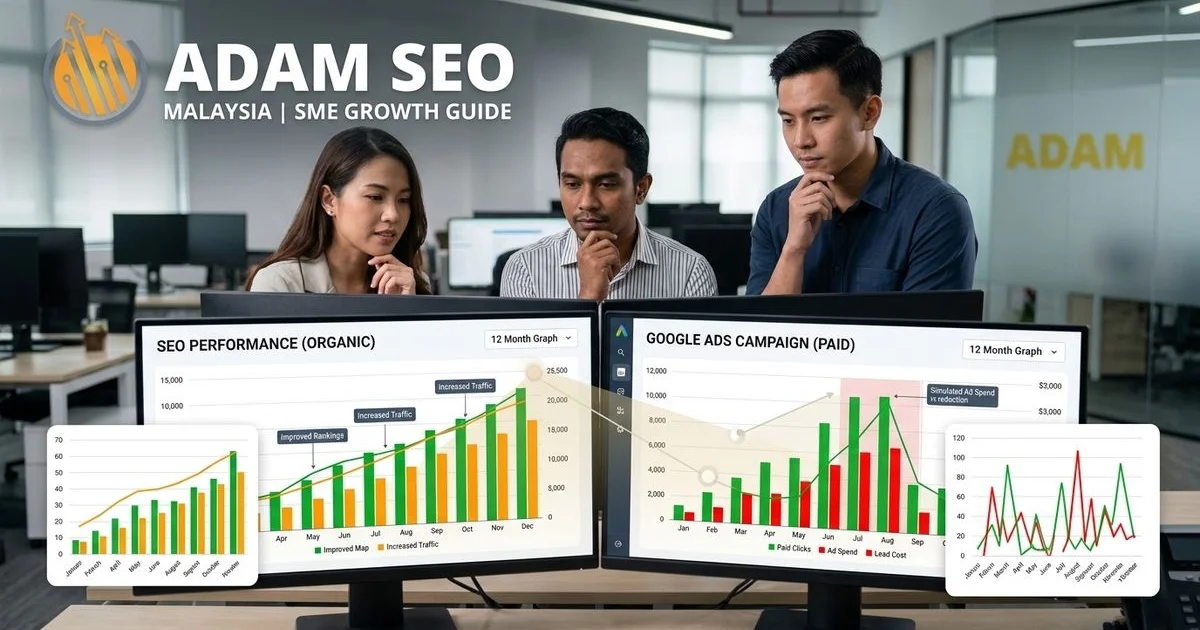
The real difference between SEO and Google Ads
The simplest way to understand the SEO vs Google Ads Malaysia debate comes down to timing and ownership.
Paid ads turn on traffic immediately in exchange for ongoing spend. Organic visibility, on the other hand, compounds over months to secure a permanent digital footprint.
We often see local marketing teams struggle to balance immediate sales with long-term brand growth. This constant pressure makes choosing between paid and organic channels feel like a high-stakes gamble.
Solving Immediate vs. Future Problems
Our agency, founded by Adam Yong in 2011, has consistently proven that search rankings mean nothing without tangible business returns. You own your organic traffic, and it does not stop the moment a budget is paused.
For Malaysia SME marketing, the most useful frame is to ask which problem you are solving this quarter. Launching a new product or testing local positioning requires instant feedback.
Google Ads buys you that data quickly by letting you test specific variables.
We use this rapid feedback loop to validate several core campaign elements:
- Which specific ad copy generates the highest click-through rate.
- Whether users in Kuala Lumpur convert differently than those in Penang.
- Which landing page layouts actually drive phone calls or form fills.
Stabilising acquisition costs and reducing platform dependence require a completely different approach. The Malaysian Digital Association reports that 78% of local consumers conduct online research before making purchase decisions.
Capturing that vast research phase is where SEO shines as a permanent lever, and both channels can run together when the budget allows.
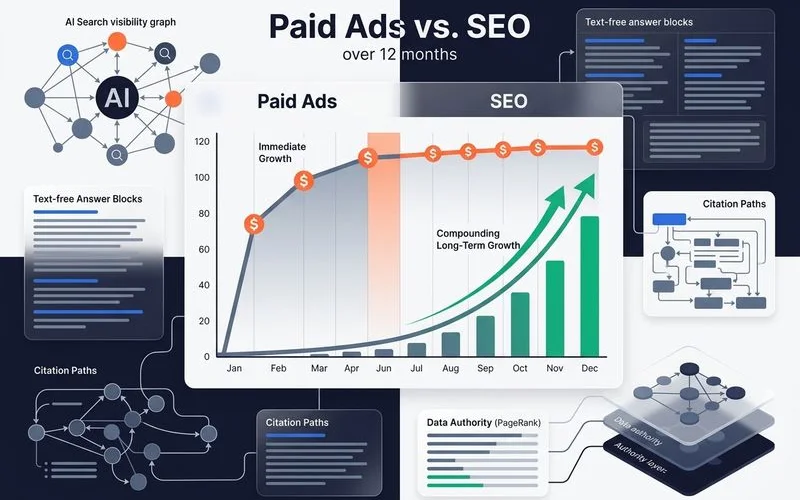
Cost-per-acquisition over time
Google Ads costs remain highly predictable based on your daily budget, whereas SEO costs are front-loaded but drop significantly as your traffic compounds over time. By month twelve, a well-run organic strategy often costs much less per qualified lead than a strictly paid approach.
Predicting your exact customer acquisition cost requires understanding how organic search vs paid ads behave financially. You spend more money to get more clicks with ads, limited only by the ceiling that industry CPCs allow.
Recent 2026 data from Specflux shows the average Google Ads Cost Per Click for Malaysian businesses typically falls between RM 3 and RM 15. We recommend SMEs allocate a starting monthly ad budget of RM 1,500 to RM 5,000 to give the algorithms enough conversion data.
The Organic Compounding Effect
Search engine optimisation costs are front-loaded but produce a completely different financial shape over time. Months one to three feel expensive because there is little visible return.
Our team prepares clients for this early phase by focusing on technical fixes and content creation. By months four to eight, growth starts compounding for businesses that pick the right keywords and invest in real content.
By month twelve, well-run SEO often costs significantly less per qualified lead than paid acquisition. The same flat monthly retainer continues to harvest a growing organic footprint across search engines.
| Channel | Speed to first leads | Cost trend over 12 months | Resilience when you pause |
|---|---|---|---|
| Google Ads | Days | Stable or rising with competition | Traffic stops immediately |
| SEO | 3-6 months | Falling cost per lead as rankings compound | Traffic continues, slowly decays |
| Hybrid | Days for ads, months for organic | Best blended CAC after 6-12 months | Organic remains while paid pauses |
When a hybrid strategy makes the most sense
A combined approach works best when you have time-sensitive offers requiring immediate visibility, or when you need paid conversion data to inform your organic priorities. Running both channels simultaneously makes perfect sense when competing in a saturated category where waiting for organic rankings alone is too slow.
We frequently use this dual method to secure quick wins while testing different landing pages to gather hard data on what converts best. Conversion Rate Optimisation clearly benefits both strategies.
A higher conversion rate on landing pages improves your blended ROI and reduces the volume of clicks needed from any source.
Bridging the Language and Intent Gap
Malaysian search behaviour is uniquely layered due to the mix of Bahasa Malaysia, English, and Chinese queries. Our strategy involves matching the right marketing channel to the specific language intent.
A user searching for a quick, localised commercial service might respond best to a targeted Google Ad. We have seen regional SMEs benefit immensely from running Google Ads for high-intent commercial queries, such as a Johor Bahru plumbing service needing immediate visibility for emergency repairs.
Simultaneously, building SEO authority around informational and comparison content captures broader research traffic. Creating detailed, localised guides answers the questions your customers ask before they are ready to buy.
Why Quality Score Matters
Google Ads uses a Quality Score metric, ranging from 1 to 10, to judge the relevance of your ads and landing pages. Improving your landing page experience to boost this score directly lowers your Cost Per Click.
These same page experience improvements, such as faster load times and clearer mobile formatting, directly satisfy Google’s core organic ranking signals. This structure keeps your near-term pipeline strong while the longer-term moat compounds underneath.
What this means for your next move
If you are starting fresh, launch Google Ads on tightly scoped commercial keywords first, then invest in SEO once you identify the exact queries that drive revenue. If you already run ads, your next move is identifying which expensive clicks could be replaced by earned organic rankings.
Choosing SEO or Google Ads always depends entirely on your current data and available resources. Directing paid traffic to a single, highly optimised landing page minimises wasted spend.
Our client data shows that this initial testing phase prevents costly mistakes in long-term content strategies.
Auditing Your Current Setup
If you already run active campaigns, consider where you pay for clicks that could be earned organically. Ranking naturally for expensive terms immediately lowers your blended Customer Acquisition Cost.
Businesses currently investing in organic growth but feeling impatient should look at targeted ad spend. A well-managed paid campaign easily bridges the visibility gap until those valuable rankings compound.
We highly recommend reviewing your analytics to identify these exact gaps and opportunities. To talk through your current marketing mix, request an SEO audit and our team will review which channels pull their weight. Reallocating your budget based on hard data consistently produces better leads at a much lower blended cost.