

From what I see across the Malaysian market, the timeline to profitability is the single biggest question executives have. You invest in search visibility because you want a predictable pipeline, not just higher traffic numbers.
This impatience is completely justified.
Our strategy sessions always start by setting realistic expectations based on hard data. Let’s look at the numbers behind these timelines and explore practical ways to track your true return on investment.
What “SEO results” actually means
When clients ask, “how long does seo take?”, the specific seo results timeframe depends entirely on what counts as a successful result. Movement in rankings can appear in just three to four weeks, especially after deploying technical fixes or updating metadata.
Our typical Malaysian SME engagements show visible commercial traffic growth within three to six months. Measurable revenue impact often appears between months four and eight, although highly competitive sectors might take longer. Compounding gains typically show up from month nine onwards, where the same monthly retainer produces growing returns.
| Result Type | Typical Timeframe | Key Milestone |
|---|---|---|
| Technical Indexing | 3 to 4 weeks | Google crawls and indexes updated metadata. |
| Traffic Growth | 3 to 6 months | Commercial keywords reach page one. |
| Revenue Impact | 4 to 8 months | Conversion-focused pages generate qualified leads. |
| Compounding ROI | 9 to 12+ months | New content ranks faster due to high topical authority. |
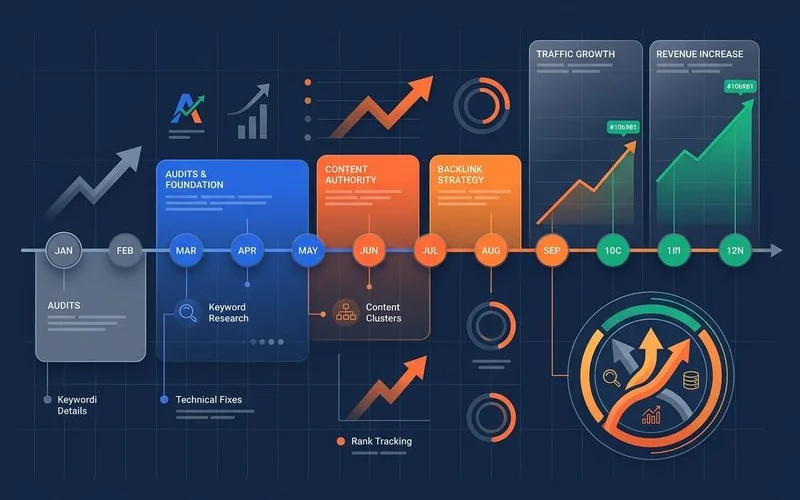
These ranges are not guaranteed promises. The variables that shift the timeline are real factors like existing site health, content depth, backlink profile, and how quickly your team executes recommendations.
We frequently see that a business actively publishing content clusters will outpace a competitor relying on single blog posts. Topical authority plays a massive role in 2026, meaning a connected web of pages performs much better than isolated articles.
A realistic month-by-month view
A standard seo timeline moves from a technical SEO foundation in month one to content building in months two through four, followed by traffic growth by month six. You will typically see compounding financial returns between months nine and twelve as your topical authority solidifies.
The Foundation and Content Phases (Months 1-4)
During the initial technical phase, resolving issues with your composite Core Web Vitals score is critical. The March 2026 Google core update aggregates LCP, INP, and CLS into a single performance score, so failing even one metric can suppress your rankings.
Our team prioritises these technical fixes before pushing any new content live. Once the technical base is secure, the strategy shifts to creating high-quality content clusters. You must prioritise “Information Gain” by adding unique insights rather than just repeating what competitors already say.
Months two to four are exactly when foundational content goes live and internal linking starts forming strong pillar and cluster patterns.
The Growth and Compounding Phases (Months 5-12)
Months four to eight are usually when measurable ranking and traffic movement becomes highly visible. Commercial keywords with reasonable competition start appearing on page one, and conversion-focused pages begin producing qualified leads.
Our reporting during this phase starts showing patterns that easily justify your continued marketing investment. Months nine to twelve are where compounding truly kicks in for your business. New content earns rankings faster because your domain authority is stronger, which pushes your customer acquisition cost lower than paid channels.
Most Malaysian businesses investing RM 1,500 to RM 5,000 monthly will see these compounding benefits clearly by the end of year one.
Why competition and history matter
The timeline for your results depends heavily on how competitive your specific industry is and the historical health of your domain. A clean, established service website can see wins in six months, while a new e-commerce store might need eighteen months to break through.
Two Malaysian businesses with the exact same retainer can experience very different ranking trajectories. A brand new independent store entering a competitive consumer category must fight against massive platforms like Shopee and Lazada.
Our strategy for these challenging retail environments focuses on highly specific, long-tail product queries to capture market share gradually. Domain history matters just as much as your current competition level.
- Algorithmic Penalties: The March 2026 spam update heavily targeted scaled AI content abuse and expired domain manipulation.
- Manual Actions: Sites with prior manual actions, link spam, or aggressive past tactics need a dedicated recovery phase.
- Topical Authority: Sites with strong existing topical relevance move much faster because Google already considers them credible.
We always start recovery plans for penalised sites by cleaning up toxic backlinks and auditing poor-quality content. You cannot expect normal growth to resume until these historical trust issues are completely resolved.
What good reporting looks like during the timeline
Effective SEO reporting must connect technical search metrics directly to your actual business revenue and lead generation goals. You should expect monthly updates that track organic entrances to solution pages, not just arbitrary keyword rankings.
We firmly believe that visibility means nothing if it fails to drive tangible commercial outcomes.
Reports should connect activity to outcomes, not just deliverables.
A ranking report that does not explain what new leads or revenue pages were affected is incomplete. We push every Adam SEO engagement toward reporting that ties keywords to pages, pages to leads, and leads to revenue.
Reporting should always be completely transparent about what is underperforming in your campaign. Sometimes a keyword that looked highly attractive during initial research completely underperforms in actual conversion rates.
Our analysts actively flag these moments so you can reallocate effort instead of wasting budget on stagnant terms. Good partners will quickly point out when a competitor pulls ahead due to sudden external moves. B2B businesses require specific metrics, like the growth of non-branded organic entrances to solution pages.
We configure tracking to ensure your data shows exactly how many procurement teams are finding your site. Tying technical search improvements directly to your CRM pipeline data makes it much easier to justify development costs.
Where to go next
Taking the next step requires understanding exactly how these timelines apply to your specific financial goals and industry context. Understanding exactly when seo works for your specific niche requires a customised roadmap that accounts for your current website health and competitive landscape.
Our team provides an executive-friendly view on what an SEO retainer actually buys, breaking down specific service scopes by tier. For detailed technical timelines, the technical SEO audit guide explains what a discovery pass covers and how long fixes typically take.
Reviewing these guides will help you understand our core deliverables:
- Strategic discovery passes and timeline mapping.
- Technical issue resolution speeds.
- Budgeting for long-term content marketing.
The fastest way to get clarity is to evaluate your current baseline. If you want a calibrated timeline for your specific site and category, simply request an SEO audit.
We will build a detailed, phased plan structured around your existing foundations and immediate commercial priorities. Stop guessing about your timeline and start executing a data-driven strategy today.