
We founded Adam SEO in 2011 to focus on tangible business results instead of chasing vanity metrics. That practical focus is exactly why the shift to AI-assisted search requires your immediate attention. Malaysian buyers are fundamentally changing how they discover local businesses and services.
We will break down exactly what this means for your visibility and share practical steps to secure your position.
A January 2026 study by Vodus Research revealed that 50% of consumers now use a blended approach, relying on AI tools for initial ideas before verifying facts on Google.
What AEO and GEO actually mean
AEO stands for Answer Engine Optimization, which is the practice of structuring content so tools like Perplexity can extract clear, concise answers. GEO means Generative Engine Optimization, the strategy of becoming a highly credible source that systems like ChatGPT and Google AI Overviews cite in their responses. Both disciplines depend on the exact same SEO foundations like crawlable pages and entity clarity.
The difference lies entirely in execution. AEO emphasizes direct-answer formatting and explicit question-and-answer structures. GEO requires consistent brand attributes and deep topical authority across multiple external properties.
This basic comparison highlights the primary distinctions:
| Feature | Answer Engine Optimization (AEO) | Generative Engine Optimization (GEO) |
|---|---|---|
| Primary Focus | Extractable direct answers | Brand credibility and citations |
| Key Tactic | FAQ schema and structured blocks | Digital PR and entity management |
| Target Platforms | Featured snippets, Perplexity | ChatGPT, Gemini, AI Overviews |
Why this matters for Malaysian businesses
This matters because Malaysian buyers increasingly mix traditional Google search with AI assistants for upper-funnel research. A founder shortlisting SEO agencies might first ask ChatGPT for recommendations before verifying those choices on Google. A consumer researching dental treatment might consult AI Overviews before clicking on traditional website results.
The brands that appear in these AI responses earn a massive discovery advantage. Google quietly expanded AI Overviews advertising to Malaysia in December 2025. Competitors can now purchase ad space directly within these AI summaries.
The reality for local businesses: AI search is no longer an experiment. It is a fully monetized acquisition channel that your competitors can utilize today.
The shift is gradual but highly strategic. Google organic search still drives most commercial demand today.
You need to treat AEO and GEO readiness as a current priority instead of a future concern. Our AI Search Strategy service is structured exactly around closing this gap.
Signals that influence AEO and GEO
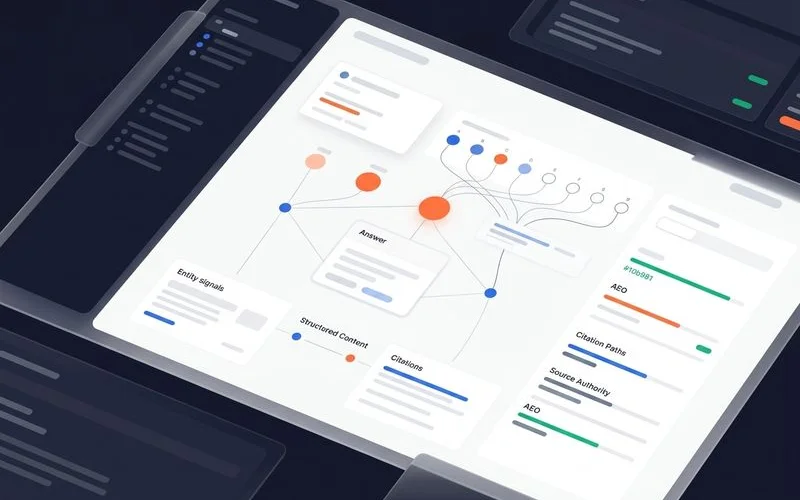
The most influential signals include clear brand entity definitions, highly structured content, comprehensive schema markup, and strong source authority.
Entity clarity, source authority, and structured content matter as much as backlinks.
AI engines weigh brand attribute consistency, citation density, and answerability over many of the traditional ranking factors.
A March 2026 GEO Benchmark study by ConvertMate revealed the actual impact of these ranking factors. Pages with a structured heading hierarchy make up 68.7% of all cited AI sources. In fact, 61% of those successfully cited pages use proper schema markup.
Here are the specific signals you need to optimize:
- Clear brand entity definition: Use the exact same name, services, and location across your site and external profiles.
- Structured content: Break text into clear headings, definition statements, and decision frameworks.
- Schema markup: Implement specific tags like Organization, FAQPage, and LocalBusiness schema.
- Source authority: Secure mentions from trusted industry publications that AI models use for training.
Traditional SEO foundations remain the absolute prerequisite for success. AI engines often crawl the same web that Google does. They generally treat well-ranked and technically sound content as far more credible.
How AEO and GEO work practically
A practical workflow involves researching the exact questions your buyers ask AI tools and tracking your inclusion in answer surfaces over time. A typical AEO process includes restructuring relevant content with answer-ready blocks and adding FAQ schema where appropriate.
You also need a dedicated GEO workflow to map your brand footprint across owned and external sources. This practice helps you identify authority gaps across niche sites and expert profiles.
We highly recommend using dedicated 2026 monitoring tools like ZipTie.dev or Mentionable to track these metrics. Traditional rank trackers cannot accurately measure your visibility inside a ChatGPT response or a Gemini summary. These tools provide the insights needed for this proven four-step process:
- Audit current visibility: Run your primary keywords through an AI tracking tool to establish a baseline.
- Identify trigger questions: Find the specific, long-tail questions generating AI responses in your niche.
- Rewrite core content: Update your service pages to include direct, one-sentence definitions at the top of sections.
- Implement structured data: Add Organization and FAQPage schema markup to all high-priority landing pages.
Where to go next
For a practical starting point, our comprehensive guide on how to rank in AI Overviews and answer engines covers this exact workflow in much more detail. You might also wonder if this approach makes financial sense for your specific industry right now.
To answer that question, please review our breakdown on is AI search strategy right for my business.
Once you start appearing in AI answers, our guide on how to track your brand’s visibility in ChatGPT shows how to monitor and measure it.
To assess your current readiness, you can request a discovery audit directly from our team. We will benchmark your entity footprint and structured content against the available market opportunity.