
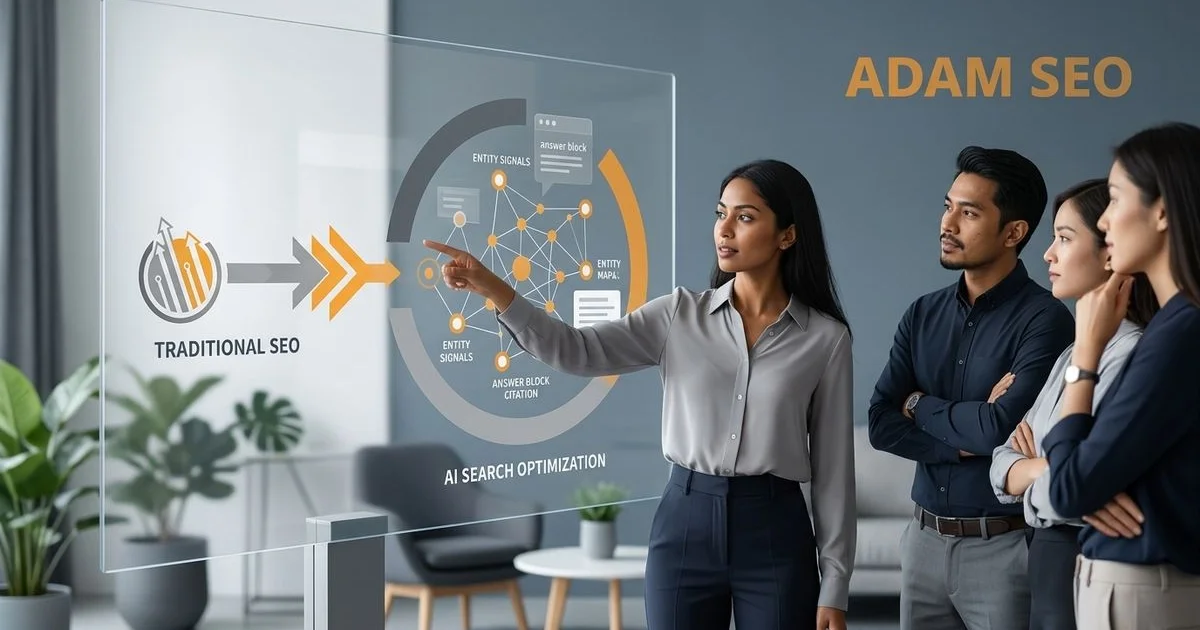
Let’s look at the data to see why the debate around ai search optimization vs seo is suddenly so critical for your bottom line. We see a lot of confusion right now as traffic patterns shift across Google and newer chat tools.
This disruption forces a massive migration in user behaviour. Many local businesses notice a sudden drop in traditional organic clicks, even when their keyword rankings hold steady.
Our analysis proves that platforms like ChatGPT and Google Gemini are actively taking over the top of the research funnel. Since Adam Yong founded Adam SEO in 2011, our core premise has always been that rankings are meaningless without tangible business results. We apply this same logic to the current search landscape to protect your revenue.
The following breakdown explains exactly what has changed and offers a practical way to manage both strategies without burning your budget.
What overlaps and what differs
Traditional SEO and AI search optimization share core technical requirements, but they differ sharply in how your content is formatted and measured. Both systems need clean, crawlable pages and strong authority signals to trust your business.
These shared requirements include:
- Fast page loading speeds.
- Logical site architecture.
- Clear, descriptive URL structures.
We know that building a solid topical map is still the price of admission for any visibility. The real divergence happens in the presentation. While classic search targets the ten blue links, the shift toward ai search vs google seo focuses on answer surfaces where your brand might be cited.
Our recent audits show that generative systems like Google’s AI Overviews now appear in nearly one-third of all search results. For businesses in Malaysia, adapting to this means structuring content so these engines can extract specific claims without losing context. A 2026 Statcounter report shows ChatGPT holds a 72.68% market share of AI chatbots locally.
We format our client pages with clear definitions and FAQ schema to feed these specific platforms directly.
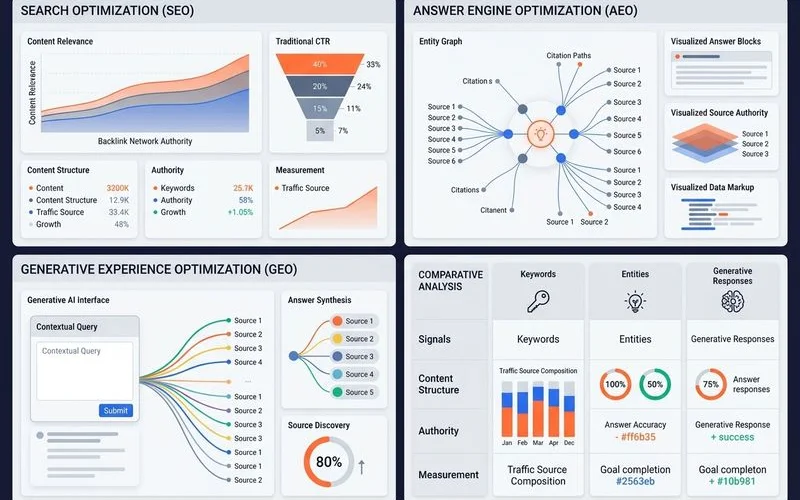
A side-by-side comparison of ai search optimization vs seo
A side-by-side look reveals that while traditional search measures traffic from rankings, AI optimization tracks your citation share across generative answers. The table below outlines these structural differences clearly.
| Dimension | Traditional SEO | AI Search Optimization |
|---|---|---|
| Primary surfaces | Google organic, Bing organic | AI Overviews, ChatGPT, Perplexity, Gemini |
| Critical signals | Content depth, backlinks, technical health | Entity clarity, structured content, source authority |
| Content structure | Comprehensive long-form, varied formats | Answer-ready blocks, FAQ schema, clear definitions |
| Measurement | Rankings, traffic, conversions | Prompt tracking, citation share, content coverage |
| Time to results | 3-12 months for compounding | 3-9 months for measurable inclusion |
| Foundation requirement | Required | Required (SEO is prerequisite) |
| Competitive moat | Authority and content depth | Entity consistency and structured signal density |
Our team tracks these shifts daily to understand where the real opportunities lie. Recent industry data from 2026 shows AI Overviews can reduce organic click-through rates for position one by up to 58%. This staggering drop explains why measuring success solely by traditional traffic is no longer sufficient.
We adjust our reporting to include prompt tracking and brand mentions within platforms like Perplexity. Aeo vs seo comparisons often highlight this shift in measurement as the biggest hurdle for marketing teams. Professional usage of Perplexity in Malaysia grew 340% through 2025, proving these alternative engines are gaining serious traction.
When traditional SEO should lead
Lead with traditional SEO if foundations are weak or rankings are missing.
AI search rewards strong foundations. Investing in AI search before classic SEO is stable usually produces disappointing returns.
You must prioritize traditional SEO if your website lacks basic technical health, localized content, or stable keyword rankings. AI search heavily rewards sites that already possess a strong foundational footprint.
We constantly remind clients that skipping the basics will break any advanced campaign. Malaysia’s e-commerce sector is projected to hit RM 180 billion by 2026. Capturing that transactional value requires clean product architecture and fast page speeds first.
Our initial six to twelve months with a new local partner always focus on these technical foundations. Genuine bilingual content architecture is particularly crucial here, as Bahasa Malaysia search intent often differs entirely from English queries. Only after your organic traffic stabilizes does an advanced AI Search Strategy become a highly effective extension.
When AI search adds the most value
AI search optimization becomes highly profitable when your target audience conducts deep research before buying, and your competitors are already appearing in AI summaries. This strategy shines in B2B services, professional firms, and complex consumer categories.
Dominating the Research Phase
We see the biggest revenue lifts when optimizing for high-consideration purchases. Users planning complex investments turn to conversational tools to compare options and verify specifications. OpenAI confirmed that ChatGPT now handles over one billion queries weekly globally.
Our strategy here involves answering specific, technical questions clearly within the first 150 words of a page. This formatting technique directly feeds the large language models parsing your site.
Securing Local Market Share
Local discovery has fractured entirely over the last year. We used to rely on the standard Google map pack for local queries. Now, an AI Overview often summarizes the best options right at the top of the screen.
Our audits show that entities with clear, structured location data dominate these new local AI summaries. To adapt, businesses must maintain flawless citation consistency across all local directories.
How a combined program looks
A combined campaign structures itself into three distinct phases, prioritizing technical health first and layering in generative optimization later. This sequenced approach ensures sustainable growth without wasting resources on premature tactics.
We never recommend abandoning classic search entirely. The first six months must focus heavily on measurable organic traffic and conversion improvements. This initial phase builds the authority required for generative engines to trust your domain.
Our AI search work begins in parallel, typically starting with a comprehensive entity audit and content restructuring. This parallel track includes three distinct steps:
- Auditing existing page schema for accuracy.
- Formatting core service pages to answer direct questions.
- Expanding the topical map to cover localized queries.
By months nine to twelve, the visibility from generative engines starts to compound alongside your standard organic presence. Geo vs seo strategies actually work best when they run in tandem. We consider this the most reliable model for regional brands wanting to dominate the entire search landscape.
Where to go next
Moving forward requires a clear assessment of your current technical baseline and a roadmap for AI inclusion. Start by understanding the core definitions, reviewing budget expectations, and looking at practical implementation steps for ai search optimization vs seo.
For the definitional starting point, see AEO and GEO meaning. We keep pricing transparent so you can plan your marketing budget accurately. For pricing, see AEO and GEO pricing in Malaysia.
Gaining actual visibility requires specific on-page adjustments. For practical AI search work, see how to rank in AI Overviews. Our team is ready to review your current setup and identify the best starting point.
To assess your current readiness and design a sequenced program, request a discovery audit.