

What ranking in AI surfaces really means
We track these shifts daily, and the data reveals a massive migration in user search behaviour. Organic click-through rates are dropping as generative responses answer queries before a user ever clicks a link. Recent 2026 data shows that 58.5% of Google searches now end without a click to any website, making it critical to learn how to rank in AI overviews.
Our team at Adam SEO, founded in 2011 by SEO veteran Adam Yong, was built on the premise that rankings are meaningless without tangible business results. A solid AI Search Strategy treats this shift as a probability game.
Skipping any fundamental answer engine optimization layer will limit your visibility.
Layer one: content structure
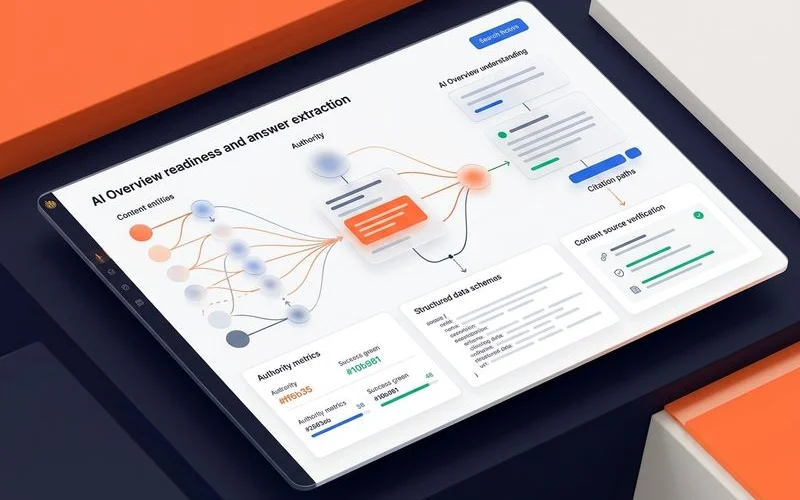
Answer engines extract information from pages that present clear, well-structured answers. A 2026 Semrush study of 10 million keywords found that semantic completeness is the primary ranking factor for AI overview SEO. Content scoring highly in completeness is 4.2 times more likely to be cited as a source.
We achieve this by writing direct, declarative sentences that AI systems can confidently parse. Walls of text rarely earn inclusion because the extraction process requires simple formatting.
The most effective formats use specific elements to signal value to language models:
- Direct Answers: Answer the primary query immediately in a 50 to 70-word summary right after a strong H2.
- Structured Elements: Use comparison tables, structured FAQ blocks, and decision frameworks.
- Self-Contained Units: Keep informative passages between 134 and 167 words to align with AI extraction preferences.
- Schema Markup: Implement FAQ schema for user intent, HowTo schema for procedures, and Article schema with author references.
Our approach prioritises clear paragraph breaks and definition statements early in the page. These structured signals make information retrieval faster and far more reliable for generative engines.
Layer two: entity clarity
AI engines build internal entity graphs that map concepts, brands, and real-world relationships. If a business has inconsistent attributes across the web, AI systems struggle to confidently attribute information back to that source. This creates a massive gap for local Malaysian SMEs with outdated directories.
Our recent audits show that unlinked brand mentions now carry heavy weight. A 2025 Ahrefs study of 75,000 brands revealed that branded web mentions have a much higher correlation with AI Overview inclusion than traditional backlink quantity. Search systems validate answers by looking for external authority mentions.
We fix entity confusion by focusing on three essential validation steps:
- External Audits: Clean up inconsistent naming and service descriptions across all external profiles.
- Organization Schema: Implement code that explicitly maps your business details for search crawlers.
- Narrative Alignment: Ensure your About page, contact information, and team bios match your canonical brand identity perfectly.
These steps prevent AI confusion and secure your place as a recognised entity.
Layer three: source authority
AI engines tend to cite sources that other authoritative publishers already reference. Traditional link building still matters, but the goal extends to citation in trusted publications, niche industry sites, and expert profiles. Recent usage data shows that models like ChatGPT heavily prioritise established platforms to verify claims.
Our strategy for Malaysian businesses involves a targeted mix of local trust signals. Securing local industry directory listings, contributing expert quotes, and executing structured PR campaigns build regional relevance. Multi-modal content that combines text, images, and video drives 156% higher selection rates in generative summaries.
The role of author credentials
Schema markup that explicitly identifies authors, qualifications, and expertise provides another critical ranking factor. Real expertise signals, including author bios and published credentials, hold significant weight in the 2026 search landscape.
We ensure that every author profile links back to verifiable professional accomplishments. This transparency satisfies the stringent fact-checking filters used by generative answer models.
Layer four: measurement
AI visibility measurement is imperfect but improving.
Track inclusion through prompt testing, third-party tools that monitor brand citations across AI surfaces, traditional ranking proxies, and content coverage analysis.
Practical measurement includes maintaining a list of prompts that represent your buyers’ actual AI search usage. You should periodically test inclusion through direct queries to track patterns over time. Industry data shows that position one organic click-through rates drop by 54% when an AI Overview is present.
Our teams use brand citation monitors and prompt-tracking platforms that are maturing quickly. Monitoring branded search volume serves as a reliable proxy for upstream AI influence. We recommend expanding your measurement stack with tools like Ahrefs Brand Radar or Semrush AI Toolkit to benchmark your visibility against regional competitors.
A realistic timeline
The transition to consistent generative visibility requires patience and structured execution. The following timeline outlines the expected progression for a standard implementation.
| Phase | Months | Expected outcomes |
|---|---|---|
| Foundation | 1-2 | Content audit, entity audit, structured data implementation |
| Restructuring | 3-4 | Priority page rewrites with answer blocks, FAQ schema additions |
| Authority | 5-7 | Citation and authority signal building |
| Compounding | 8+ | Increased inclusion across relevant queries, measurable brand citation share |
The compounding phase is where consistent AEO and GEO work starts producing visible advantages over competitors.
Our clients typically see a massive shift in traffic quality once they reach this final stage. The targeted answers provided by AI systems deliver highly qualified leads straight to your site.
Where to go next
Finding the right starting point requires understanding the core concepts of generative optimization. For the definitional foundation, our AEO and GEO meaning guide explains the discipline clearly to help you rank in answer engines.
We encourage you to evaluate your current positioning before making major changes. To assess whether your business is ready, see is AI search strategy right for my business.
To get a structured AI visibility roadmap, request a discovery audit.
We will assess your current foundations against AEO and GEO requirements to build a customised plan.