
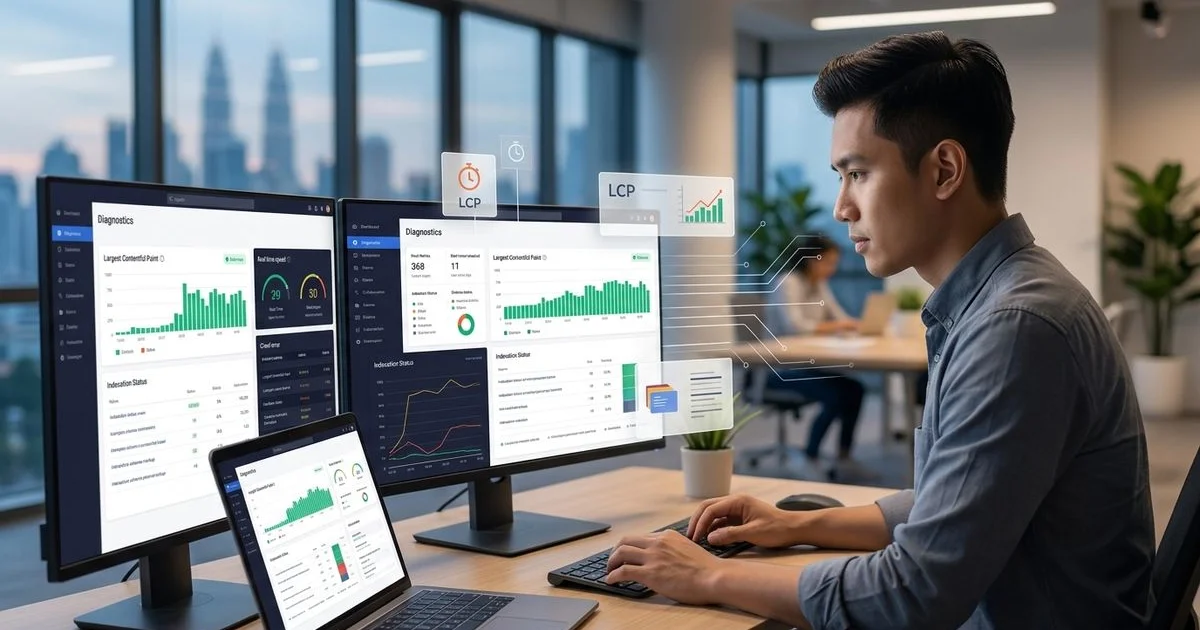
You know how frustrating it is when a website takes forever to load, and just as you tap a button, the whole page jumps. This is exactly the problem we tackle with core web vitals SEO strategies.
We see companies pour thousands of Ringgit into content, only to lose customers because their mobile site feels sluggish.
The data tells us that technical performance SEO is now a non-negotiable foundation for digital growth. Let’s look at the numbers, what they actually mean for your business, and then explore a practical framework to fix these bottlenecks.
What Core Web Vitals SEO metrics actually measure
We know that these three user experience metrics help Google evaluate page performance. These specific signals measure loading speed, responsiveness, and visual stability directly from real user data.
Our team at Adam SEO, founded in 2011 by Adam Yong, was built on the premise that search engine rankings alone are meaningless without tangible business results. Performance optimisation must account for actual customer device limits and connection speeds to drive those results.
We look at three distinct areas of the user journey, specifically LCP, INP, and CLS:
- Largest Contentful Paint (LCP): This tracks loading speed and measures when the main content becomes visible.
- Interaction to Next Paint (INP): This evaluates responsiveness when a user taps or clicks.
- Cumulative Layout Shift (CLS): This monitors visual stability to ensure elements do not jump around.
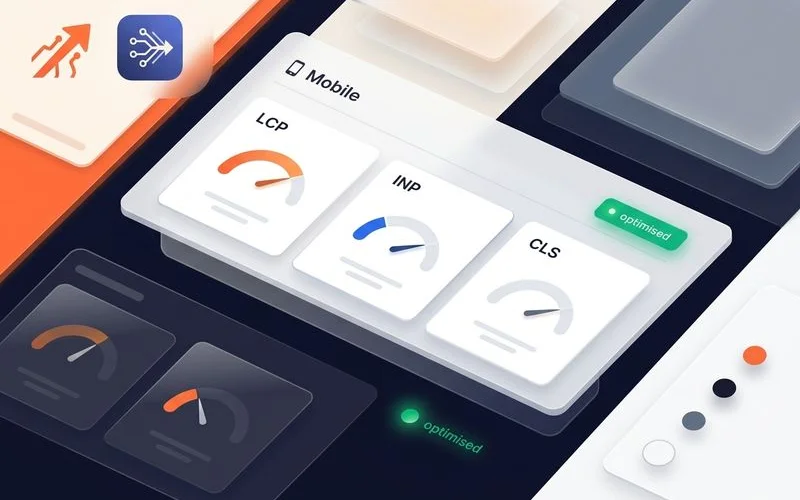
For Malaysian websites, where most traffic is mobile, these field metrics act as a highly accurate proxy for how customers experience your site. A lab test in Kuala Lumpur might show excellent results on a high-speed fibre connection. However, that same site often performs poorly for a real customer in a rural kampung using a slower 4G network.
Our research highlights that Xiaomi remains the most popular smartphone vendor in Malaysia, capturing an 18 percent market share in early 2025. This statistic proves that your typical user is likely browsing on a mid-range device. We must optimise for realistic processing power, not just ideal lab conditions.
The three metrics in business terms
We translate these technical scores directly into business impact. Each metric represents a specific friction point that causes visitors to abandon your website.
Largest Contentful Paint (LCP)
Our target for LCP is always under 2.5 seconds. This metric simply measures how long it takes until the main content of the page is visible to your customer.
Common causes of a poor LCP score include slow server response times, large unoptimised hero images, and render-blocking CSS. Heavy JavaScript often delays main content rendering significantly on e-commerce platforms.
We see the financial impact of this delay every day. Google’s data confirms that reducing a page load time from 3 seconds to 1 second can improve conversion rates by up to 27 percent. Every additional second makes your customers more likely to bounce.
Interaction to Next Paint (INP)
This metric measures how responsive the page feels when users tap a button or click a link. In March 2024, Google officially replaced First Input Delay with Interaction to Next Paint to provide a stricter assessment of interactivity.
Our benchmark for a good INP score is under 200 milliseconds. If the delay is longer, the website feels laggy and unresponsive to the touch.
Heavy JavaScript executing during an interaction is a frequent culprit for poor INP scores. We often recommend moving to “Island Architecture”, a modern framework technique that prevents the browser from freezing.
This approach fixes common interactivity blockers:
- Layout thrashing during dynamic visual updates.
- Third-party scripts running heavily on the main thread.
- Large DOM sizes that take too long to re-render.
Cumulative Layout Shift (CLS)
Cumulative Layout Shift measures how much visible content shifts unexpectedly during the loading phase. Our goal is to keep this score under 0.1 to maintain a stable, frustration-free layout.
Images without explicit dimensions are a notorious cause of layout shifts. Ads, embeds, or dynamic promotional banners loading after the main content also push existing elements around.
We frequently uncover issues with late-loading cookie consent banners on Shopify stores. These late additions shift the page down just as a user tries to tap the “Add to Cart” button. This forces an accidental click, which frustrates the buyer and damages the conversion rate.
How page speed SEO affects ranking and conversion
We view page speed SEO as a primary conversion driver, not just a search engine ranking factor. A faster website keeps visitors engaged and directly increases sales revenue.
Performance lift produces measurable revenue, not just ranking.
A site that improves mobile LCP from 4 seconds to 2 seconds typically sees double-digit conversion lift before any ranking change shows up.
Our industry data clearly shows that the ranking impact of Core Web Vitals is moderate, especially on competitive queries where many sites have similar performance. The conversion impact, conversely, is massive and immediate. Faster pages result in lower bounce rates, higher engagement, and better checkout completion rates.
For Malaysian e-commerce stores in particular, mobile performance functions as a powerful revenue lever. A recent 2026 industry analysis revealed that a 500-millisecond improvement in load time can recover roughly 5 percent in total revenue. This financial upside is part of why our technical SEO service audits weigh performance work so heavily.
A practical prioritization framework
We use a structured approach to tackle performance issues systematically. Fixing the largest bottlenecks first yields the best return on your development investment.
| Priority | Action | Why |
|---|---|---|
| 1 | Compress and lazy-load images | Largest LCP improvement for most sites |
| 2 | Audit and remove unused JavaScript | Improves INP and general responsiveness |
| 3 | Defer non-critical CSS | Improves first paint and LCP |
| 4 | Set image and embed dimensions | Reduces CLS substantially |
| 5 | Use a CDN and modern image formats | Compounds savings across all metrics |
| 6 | Audit third-party scripts | Often the biggest hidden performance cost |
Our audits consistently show that Shopify and WooCommerce stores hide their largest gains within app and plugin cleanups. Themes built before 2022 frequently need major updates to reach modern performance targets.
Recent 2026 performance benchmarks reveal that Content Management System choice matters significantly. Next.js sites currently pass Core Web Vitals at a 58 percent rate, whereas traditional WordPress setups only pass at 38 percent.
We strongly advise auditing your third-party scripts, especially live chat widgets and tracking pixels. These heavy scripts are notorious for ruining both INP and LCP scores if they load on the main thread.
Where to go next
We have compiled several resources to help you continue your core web vitals SEO journey. These guides provide deeper insights into resolving complex indexing and technical challenges.
For the broader audit framework, see what is a technical SEO audit. For indexing issues that overlap with performance, see why Google is not indexing your website.
To run a performance and technical audit on your site, request a discovery review.