

Why “traffic but no sales” is misleading
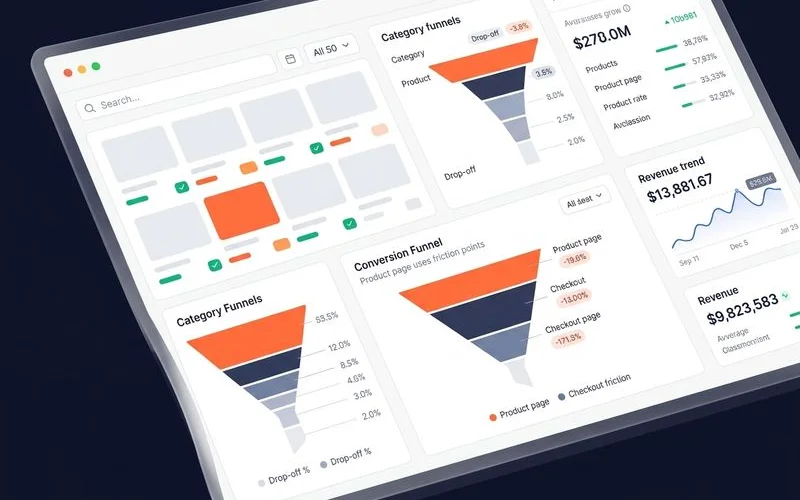
We often see founders panic when their e-commerce store analytics show rising visitors but flat revenue. That frustrating scenario of ecommerce traffic not converting usually stems from three distinct bottlenecks: intent mismatch, weak product pages, or a broken checkout flow.
Our agency, founded in 2011 by Adam Yong, operates on a simple premise. Search rankings mean nothing without tangible business results. The team diagnoses stalled growth by looking directly at those three layers to find the exact failure point.
Fixing the wrong issue wastes valuable time and marketing budget.
You can run a quick test by pulling your top ten organic landing pages. Ask yourself if these queries carry commercial intent. Are checkouts initiated from these landing pages completing?
We find that answering those three questions pinpoints the exact problem. The following steps show the required fixes needed to turn traffic into actual buyers.
Layer one: intent mismatch
Identifying the Wrong Traffic
Our analysts frequently trace poor conversion rates straight back to the search query itself. The core issue is targeting broad informational keywords instead of specific commercial terms. A blog post ranking number one for “how to choose running shoes” drives thousands of visits without producing a single immediate sale.
That behavior is completely normal. The online store traffic no sales problem happens when your entire traffic mix skews heavily into top-of-funnel research. You need a balanced strategy that targets distinct buyer phases:
- Informational: Users asking broad questions.
- Transactional: Users searching for specific model numbers.
- Navigational: Users looking for your exact brand.
Shifting to Commercial Intent
We recommend auditing your Google Search Console data using regex filters to separate these queries. Shoppers searching for “water bottle” are just browsing. Buyers searching for “500ml insulated flask blue” are ready to spend money.
Local B2B companies make this exact same mistake. A supplier targeting a broad term like “engineering company” gets irrelevant clicks. They see immediate pipeline growth when they shift to a buyer-focused term like “PLC system integrator Malaysia”.
Fixing this gap requires shifting your content focus. Prioritize category pages that list actual products and write buying-intent guides comparing specific models. Reduce top-of-funnel blogging unless it earns direct backlinks.
Layer two: product page experience
Optimizing for Speed and Trust
Once you align the search intent, the actual product page must do the heavy lifting to close the sale. Many stores lose eager buyers because of duplicate manufacturer descriptions, hidden return policies, or painfully slow layouts.
Our audits show that a mere one-second delay in mobile load time reduces conversions by up to 20%. Shoppers simply close the tab if images take too long to render. You must compress images to WebP format and defer heavy scripts to keep mobile load times under 2.5 seconds.
Building Trust With Reviews
Trust signals dictate purchasing decisions for Malaysian shoppers. Recent 2026 consumer data shows that 98% of buyers read online reviews before checkout. Displaying verifiable reviews can increase conversion rates by up to 270%.
We always check for buried call-to-action buttons during a site review. The product page SEO checklist covers these specific optimization layers in much greater detail.
Optimize the top 10 to 20 product pages first.
Revenue concentration usually follows a long-tail pattern: a small share of products produces most of the sales. Focused product page improvements on those produce disproportionate revenue lift.
Layer three: checkout friction
The final step is where most businesses silently bleed revenue due to limited payment methods and hidden costs. Regional payment data for 2026 puts the average APAC checkout abandonment rate at a staggering 68%. Customers abandon full carts due to forced account creation, surprise shipping fees, and restrictive payment options.
Our testing process simulates the exact conditions a real buyer experiences. The team runs a mobile test on a standard cellular connection using no autofill data. You should document every single point of friction.
To capture maximum sales, you must provide the payment rails your demographic actually uses:
- Integrate direct FPX bank transfers for instant payments.
- Offer TNG eWallet for mobile-first shoppers.
- Include GrabPay or ShopeePay to capture promotional spend.
- Provide a clear guest checkout option to skip account creation.
Malaysian consumers expect localized, familiar payment gateways. Relying purely on standard credit card processing is a massive mistake. Your ecommerce conversion problem shrinks immediately when you remove these basic roadblocks.
A simple diagnostic order
We use a specific checklist to audit stores experiencing traffic not converting. This framework helps prioritize the highest-impact fixes first to rapidly improve sales. Follow these steps to locate your specific drop-off points.
| Step | What to check | Common fix |
|---|---|---|
| 1 | Top organic landing pages | Shift focus to commercial queries to fix intent mismatch |
| 2 | Mobile load time (Target: < 2.5s) | Compress images to WebP, defer heavy JavaScript |
| 3 | Product page review metrics | Display user reviews above the fold to build trust |
| 4 | Add-to-cart to checkout drop-off | Remove mandatory account creation and hidden fees |
| 5 | Malaysian payment gateways | Integrate FPX, Boost, GrabPay, and TNG eWallet |
| 6 | Shipping policy clarity | State exact delivery costs before the checkout page |
Most stores fix two or three steps and see double-digit conversion lift without buying any new traffic. The goal is to maximize the value of the visitors you already have.
Where to go next
Our analysts highly recommend reviewing the foundational concepts if you want to scale further. For deeper context on the discipline, the what is e-commerce SEO guide covers the broader picture. You can also explore local benchmarks in the e-commerce SEO pricing in Malaysia breakdown.
Every store requires a specific approach to fix conversion bottlenecks. To get a calibrated SEO and CRO review for your business, request a discovery audit. We will identify the highest-impact bottleneck first and map out a clear action plan.