

We see many business owners hit a traffic ceiling when trying to master Shopify SEO Malaysia. That plateau usually happens because general e-commerce SEO advice misses the specific technical quirks of this platform.
Our team at Adam SEO, founded by Adam Yong in 2011, focuses on turning search rankings into tangible business impact.
This is crucial now because the Malaysian market is rapidly maturing, with projected e-commerce revenue hitting RM 50 billion in 2026. We are going to break down the exact performance bottlenecks holding stores back, and then outline a practical roadmap to fix them.
What makes Shopify SEO Malaysia different
The core foundation remains similar to other platforms, but the execution requires a specific approach. Our team frequently notices that default metadata settings fail to provide the granularity needed for competitive search rankings.
Collection pages carry significantly more weight than individual product pages for broad commercial keywords. We also see how app and theme choices directly dictate site speed in ways that less integrated systems avoid.
Properly configured structured data helps rich result eligibility for products and reviews. Our technical reviews across Malaysian stores consistently expose three identical weaknesses.
These include thin collection content, missing product schema, and slow Core Web Vitals caused by accumulated app bloat. We find that fixing these three issues usually produces the first wave of measurable lift.
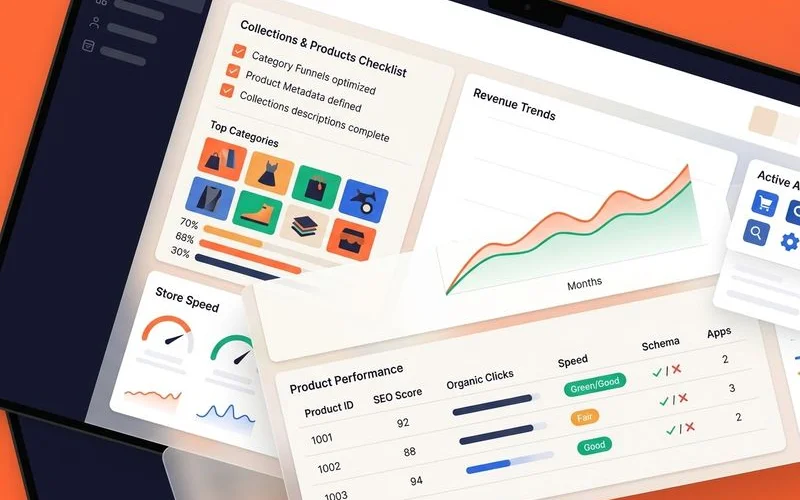
- Collection Priority: Category pages rank higher than product pages for major head terms.
- App Ecosystem Tax: Third-party plugins inject render-blocking code that requires manual deferral.
- Schema Automation: Built-in JSON-LD requires manual refinement to include specific review data.
Shopify SEO priorities in order
Establishing a clear hierarchy of tasks prevents wasted effort on low-impact changes. We organise our optimisation process into five distinct phases to guarantee maximum return on investment.
Collection Page Optimisation
Mapping each category to a clear keyword provides a strong signal for Shopify collection SEO. We recommend writing meaningful descriptions and placing them above the product grid.
Structured headings and FAQ sections help customers understand the product range immediately. Our content strategists always build internal links to relevant guides from these pages. Duplicate or thin collections compete with each other and dilute your ranking power.
Product Page Optimisation
Unique descriptions and specifications form the baseline for effective Shopify product SEO. We always implement comprehensive product schema that highlights reviews, pricing, and availability.
Dedicated review applications like Judge.me or Loox feed this schema data directly to Google for those coveted star ratings. Our developers ensure images use modern formats and lazy-loading to keep the page fast.
Technical SEO and URL Structure
The platform automatically generates duplicate URLs for products attached to collections, creating paths like /collections/all/products/item. We fix this by auditing canonical tags and adjusting theme code to point directly to the clean /products/item URL.
Checking your robots.txt file and noindex behaviour prevents search engines from indexing filtered search results. Our technical audits validate sitemap completeness to ensure new inventory gets discovered quickly.
Speed and Core Web Vitals
Recent 2026 data shows that 72.67% of Malaysian e-commerce transactions now happen on smartphones. We heavily prioritise mobile performance because Google now uses Interaction to Next Paint (INP) to measure responsiveness.
Unused code from old apps or heavy page builders creates main-thread blocking that ruins this INP score. Our performance checklist includes compressing images, picking lightweight themes, and deferring non-critical scripts.
Content Support for Buyers
Publishing supporting content earns informational traffic and builds natural backlinks to commercial pages. We use comparison articles and buying guides to address upstream questions before customers even reach a product page.
This strategy captures buyers early in their research phase. Our data shows this content support significantly improves the final conversion rate on product pages.
Common Shopify SEO mistakes
The temptation to install endless widgets often ruins organic visibility. We regularly audit stores where unnecessary plugins completely destroy loading times.
Adding more apps does not equal better SEO.
Every app you install touches your theme, scripts, and frontend performance. Even a five percent speed regression can affect ranking, conversion, and ad costs simultaneously.
A recent industry test proved that a single unoptimised review widget can increase Interaction to Next Paint by hundreds of milliseconds. We also find many merchants leaving identical manufacturer descriptions on their product listings.
Another frequent mistake involves duplicating collections, which fragments domain authority across too many weak pages. We strongly advise manually configuring your schema markup instead of relying entirely on basic theme features.
- Heavy Page Builders: Tools like PageFly can add unnecessary code if used for every simple page.
- Review App Scripts: Unoptimised widgets block the main thread and harm INP scores.
- Marketing Popups: Multiple exit-intent scripts compete for browser resources.
When to bring in specialist help
Managing a growing catalogue while handling technical search issues eventually becomes overwhelming. We suggest bringing in a Shopify SEO specialist in Malaysia when technical debt starts restricting your revenue potential.
| Situation | Specialist help recommended | Business Impact |
|---|---|---|
| 50+ products with no structured SEO work | Yes | Establishes baseline visibility |
| Stagnant rankings for 6+ months | Yes | Breaks through traffic plateaus |
| Recent platform migration to Shopify | Yes | Prevents catastrophic link loss |
| Failing INP or Core Web Vitals scores | Yes | Recovers mobile search rankings |
| Multiple sales channels and storefronts | Yes | Resolves complex canonical issues |
| Active competition from cheaper or larger brands | Yes | Identifies new content gaps |
The investment in structured technical work pays back within six to twelve months for most growing Malaysian stores. We see this return through compounding category rankings, better product visibility, and drastically lower acquisition costs.
Where to go next
Building a complete digital strategy requires understanding the wider landscape beyond just one platform. Our what is e-commerce SEO guide covers that broader picture, serving as a platform-agnostic resource.
For those needing more technical depth, the technical SEO audit cost in Malaysia breakdown explains the exact scope and pricing.
We can build a custom Shopify SEO Malaysia roadmap specifically for your store.
Simply request a discovery review to get started with a detailed analysis. Our team will provide a quote based on your catalogue size, current theme, and existing organic rankings.